Virtual Machine (VM)
This wiki entry defines a term used across VSAVM and explains why it matters in the architecture.
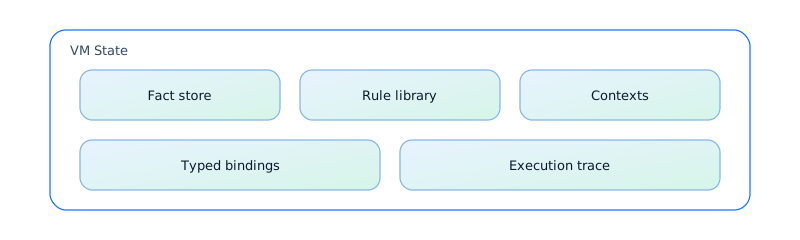
The diagram has a transparent background and highlights the operational meaning of the term inside VSAVM.
Related wiki pages: VM, event stream, VSA, bounded closure, consistency contract.
Definition
A virtual machine is an abstract execution engine that runs programs over a defined state. In VSAVM, the VM is the concrete core that holds canonical facts, applies rules, and records execution traces.
Role in VSAVM
The VM provides the state that conditions generation and enforces the consistency contract by running bounded closure and detecting conflicts. It is the authority: retrieval proposes candidates, but the VM decides acceptability via execution.
Mechanics and implications
Because the VM state is discrete, VSAVM can attach stable identifiers to claims and scope. This allows deterministic conflict checks, repeatable boundary behavior, and operational explanations derived from traces instead of from post-hoc narratives.
Further reading
Virtual machines and symbolic execution provide foundational ideas for explicit state transitions and branching exploration. VSAVM adapts these ideas for reasoning under budgets and scope.
References
Virtual machine (Wikipedia) Symbolic execution (Wikipedia) Trace (software) (Wikipedia)