Bounded closure
This wiki entry defines a term used across VSAVM and explains why it matters in the architecture.
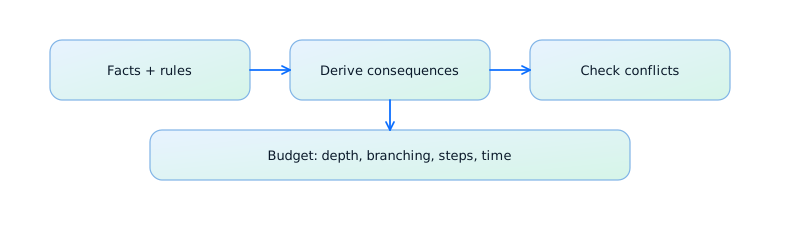
The diagram has a transparent background and highlights the operational meaning of the term inside VSAVM.
Related wiki pages: VM, event stream, VSA, bounded closure, consistency contract.
Definition
Bounded closure is a controlled approximation of transitive closure. It derives consequences of rules and executions only up to explicit limits such as depth, branching, step count, or time.
Role in VSAVM
Bounded closure is the enforcement mechanism behind VSAVM correctness. It rejects candidates that introduce contradictions within scope and determines whether a conclusion is robust, conditional, or indeterminate under the current budget.
Mechanics and implications
Closure requires canonical facts and explicit negation. Conflicts are detected when the same canonical fact identifier appears with opposing polarity in the same scope. Budgets make the exploration boundary explicit and auditable.
Further reading
Bounded closure connects to search, verification, and model checking. VSAVM uses closure as a budgeted gate that turns correctness into an operational property.
References
Transitive closure (Wikipedia) Consistency (Wikipedia) Verification and validation (Wikipedia)