Event stream
This wiki entry defines a term used across VSAVM and explains why it matters in the architecture.
The diagram has a transparent background and highlights the operational meaning of the term inside VSAVM.
Related wiki pages: VM, event stream, VSA, bounded closure, consistency contract.
Definition
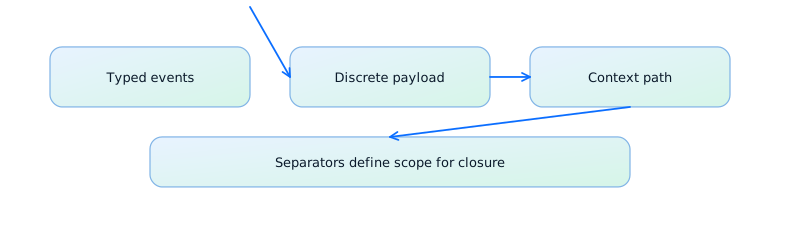
An event stream is an ordered sequence of typed, discrete events. In VSAVM, each event includes a payload and a structural context path (contextPath) that preserves scope and boundaries.
Role in VSAVM
The event stream unifies text and multimodal inputs so that the VM and bounded closure operate on a single representation. It is the foundation for schema discovery, program compilation, and scope-aware conflict detection.
Mechanics and implications
Structural separators delimit where a fact applies. VSAVM supports two complementary signals:
- Explicit structure: the ingest pipeline can emit separator-like events and stable
contextPathhierarchies (document/section/paragraph/speaker/function). - Emergent structure (DS010): when explicit structure is missing or incomplete, a VSA-based detector can propose separator positions from similarity gradients and context-path changes.
Scope is derived structurally, never from domain labels. This is enforced by createScopeId, which rejects ['domain', ...] paths.
Step-by-step: from events to scoped facts
- Ingest events into the VM (
ingestEvents), preservingcontextPathwhen available. - Detect separators (optional) using
detectStructuralSeparators(DS010). - Derive scope IDs using
createStructuralScopeId(preferscontextPath, falls back to separator-derived paths). - Attach scope to facts so closure and contradiction checks are localized.
Further reading
Event stream processing is a broad topic. VSAVM uses the term in a representational sense: explicit structure and discrete units that support deterministic parsing and auditing.
References
Event stream processing (Wikipedia) Tokenization (Wikipedia) Scope (computer science) (Wikipedia)