Trustworthy AI
This wiki entry defines a term used across VSAVM and explains why it matters in the architecture.
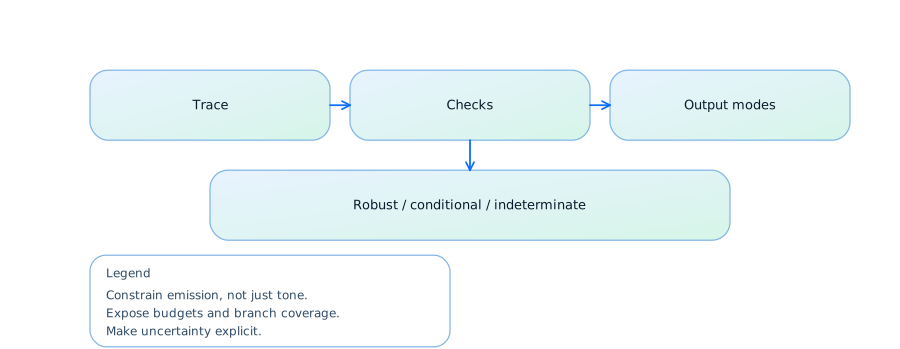
The diagram has a transparent background and highlights the operational meaning of the term inside VSAVM.
Related wiki pages: VM, event stream, VSA, bounded closure, consistency contract.
Definition
Trustworthy AI refers to systems that behave predictably and transparently, especially at the boundaries of uncertainty.
Role in VSAVM
VSAVM approaches trustworthiness by construction: it constrains emission to what can be derived and checked under bounded closure and exposes traces and budgets on demand.
Mechanics and implications
The system’s outputs are classified into robust, conditional, or indeterminate based on closure and scope. This replaces ungrounded confidence with operational coverage. The surface realizer is constrained to avoid introducing facts beyond VM state.
Further reading
Trustworthy AI intersects with explainability, verification, and alignment. VSAVM’s contribution is to provide an executable substrate that makes these concerns operational and auditable.
References
Explainable AI (Wikipedia) Verification and validation (Wikipedia) AI alignment (Wikipedia)