Schema
This wiki entry defines a term used across VSAVM and explains why it matters in the architecture.
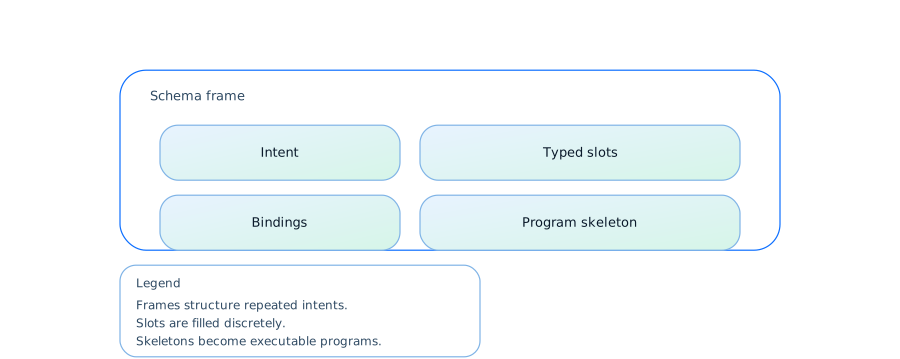
The diagram has a transparent background and highlights the operational meaning of the term inside VSAVM.
Related wiki pages: VM, event stream, VSA, bounded closure, consistency contract.
Definition
A schema is a structured representation of a recurring intent, often expressed as a frame with slots to be filled.
Role in VSAVM
Schemas are the bridge between language and execution. They constrain compilation and generation by defining what roles exist, what types are allowed, and how a surface span maps to program structure.
Mechanics and implications
Typed slots reduce branching and improve auditability. The system can log which span filled which slot and which assumptions were required. VSA can help retrieve candidate schemas, but final bindings must be validated by execution and closure checks.
Further reading
Schemas appear in cognitive science and linguistics; VSAVM uses them as an engineering abstraction that supports compilation and verification.
References
Schema (Wikipedia) Frame semantics (Wikipedia) Program synthesis (Wikipedia)