Context and scope
This wiki entry defines a term used across VSAVM and explains why it matters in the architecture.
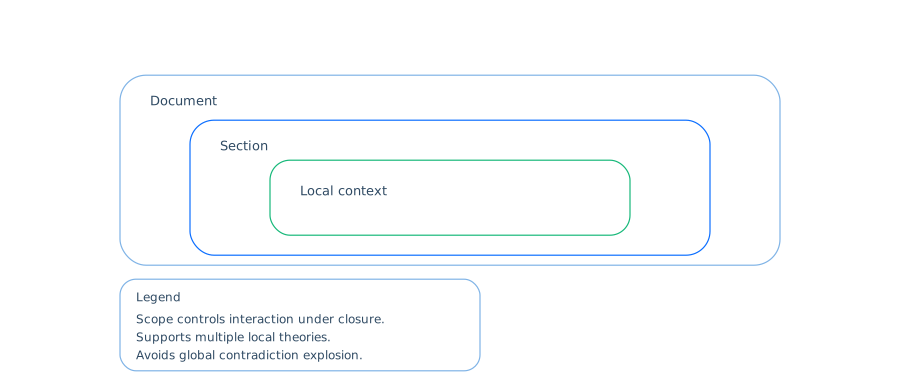
The diagram has a transparent background and highlights the operational meaning of the term inside VSAVM.
Related wiki pages: VM, event stream, VSA, bounded closure, consistency contract.
Definition
Context and scope define the boundary within which a statement is interpreted and interacts with other statements.
Role in VSAVM
VSAVM uses scope derived from structural separators to localize inference and contradiction checks. This prevents incompatible sources from collapsing into a single inconsistent base.
Mechanics and implications
Scope is carried through execution as context metadata. Conflict checks require scope: a contradiction is opposing polarity for the same canonical fact identifier within the same scope. Without scope, correctness becomes either impossible or meaningless.
In VSAVM, scopes must be structural (DS010/NFS11). The identifier layer enforces this by rejecting any scope path that starts with ['domain', ...].
Scope containment is prefix-based: a shorter path selects a larger structural region. This is what allows queries like “answer within this document/section/record” without inventing domain labels.
Further reading
Scope is a standard notion in computing; VSAVM extends it to reasoning and verification by treating document structure as semantic boundaries.
References
Scope (computer science) (Wikipedia) Context (computing) (Wikipedia) Consistency (Wikipedia)