State-space geometry and conceptual regions
This page is a theory note. It expands the topic in short chapters and defines terminology without duplicating the formal specification documents.
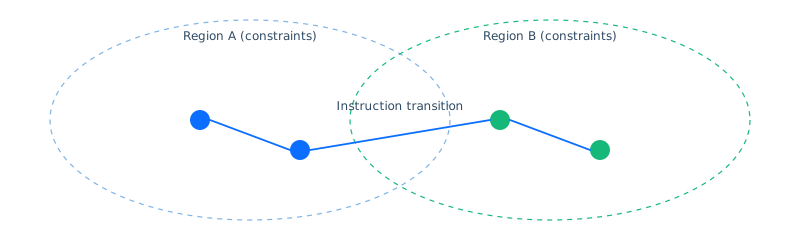
The diagram has a transparent background and is intended to be read together with the caption and the sections below.
Related wiki pages: VM, event stream, VSA, bounded closure, consistency contract.
Related specs: DS001.
Overview
A geometric interpretation of VSAVM is best expressed in the VM state space. Each instruction is a state transition, and reasoning is a path through this graph under constraints. This makes thinking more equivalent to exploring more of the reachable neighborhood.
Concepts as regions
A concept is not a single vector; it is a region of states that share invariants. For example, a contradiction is a region where opposing polarities for the same canonical fact identifier coexist in scope. A definition is a region where new identifiers and constraints are introduced with structural scope markers.
Two geometries
VSA provides an auxiliary geometry of similarity over surface forms that accelerates retrieval. The VM provides the geometry of consequences and conflicts. Separating these prevents the system from equating resemblance with truth while still benefiting from fast candidate selection.
Budgets as resolution
Budgets define exploration depth and breadth. Small budgets yield shallow checks; larger budgets reveal deeper consequences and more conflicts. This makes the system’s certainty a function of explored coverage rather than a stylistic tone.
References
Conceptual spaces (Wikipedia) State space (Wikipedia) Graph traversal (Wikipedia)