Federated growth of modules
This page is a theory note. It expands the topic in short chapters and defines terminology without duplicating the formal specification documents.
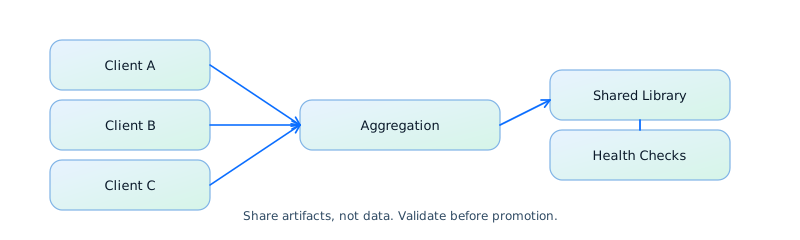
The diagram has a transparent background and is intended to be read together with the caption and the sections below.
Related wiki pages: VM, event stream, VSA, bounded closure, consistency contract.
Related specs: DS002.
Overview
Federation becomes practical when what is learned is modular. VSAVM learns discrete objects such as macro programs, schemas, and prototypes that can be shared as artifacts rather than as opaque parameter deltas. This supports incremental growth without exposing raw corpora.
What is shared
Clients can share filtered discrete statistics, VSA prototypes, and macro-program metadata such as utility and conflict rate. Hypervectors themselves can be deterministic and therefore need not be transmitted. Prototypes and rule candidates can be merged and deduplicated at the artifact level.
Governance and safety
A wrong rule can pollute the global library. VSAVM mitigates this by requiring the same consistency contract as an admission gate: candidate rules and macros must pass health checks that detect contradiction explosion or uncontrolled branching. This resembles unit testing for learned rules.
Why modularity helps engineering
Artifacts can be versioned, rolled back, and scoped. Libraries can be maintained separately by provenance (for example, per dataset or per ingestion source) without hardcoding semantic domains into scope IDs. This is easier than interpreting dense gradient updates and enables more transparent governance for research deployments.
References
Federated learning (Wikipedia) Differential privacy (Wikipedia) Knowledge base (Wikipedia)