Consistency contract and boundary behavior
This page is a theory note. It expands the topic in short chapters and defines terminology without duplicating the formal specification documents.
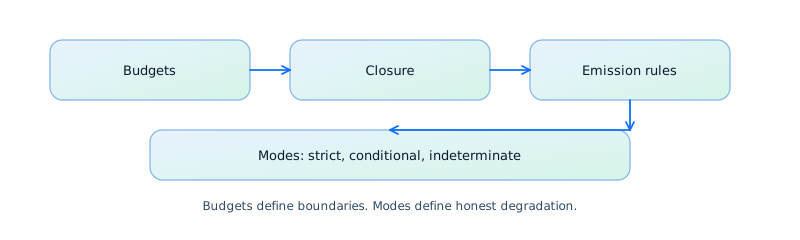
The diagram has a transparent background and is intended to be read together with the caption and the sections below.
Related wiki pages: VM, event stream, VSA, bounded closure, consistency contract.
Related specs: DS004.
Overview
The consistency contract defines what the system is allowed to emit and under what conditions. It formalizes budgets, closure behavior, and response modes. Without such a contract, the system cannot make honest claims about correctness.
Budgets and monotonicity
Budgets include depth, branching, steps, and optionally time. These parameters define exploration coverage and therefore the strength of a conclusion. Increasing budget should not merely increase confidence; it should reveal more consequences and potentially uncover conflicts, making the system more honest rather than more fluent.
Response modes
Strict mode emits only what remains consistent across explored branches. Conditional mode emits conclusions tied to explicit assumptions or branches. Indeterminate mode is returned when the system cannot justify a conclusion under the given budget. These modes are semantic commitments that prevent the system from pretending certainty.
Auditability
The contract implies logs and metadata: budget used, branches explored, rules applied, and conflicts detected. This allows operational explanations and makes the system testable. It also provides a practical mechanism to debug where and why reasoning fails.
References
Consistency (Wikipedia) Verification and validation (Wikipedia) Non-monotonic logic (SEP)